Mettl Coding Test Pattern 2026: Beat Proctoring and I/O Traps
Mettl is Mercer Mettl's online assessment platform for proctored coding tests. The 2-problem 40-min candidate pattern, flags, traps, and a 7-day drill.
on this page§ 07
The Mettl coding test pattern is not one fixed company exam. Mercer Mettl is the assessment platform behind many employer drives, so the exact number of questions, minutes, language menu, proctoring mode, and retake rule are configured by the hiring company. For 2026 freshers, the highest-utility preparation model is the candidate-reported 2 coding problems in a 40-minute window, auto-graded on test cases, with possible webcam, screen recording, and browser lockdown. Your scoring edge is simple: one full solution, one strong partial, zero I/O mistakes.
Pattern: What The Mettl Coding Simulator Usually Contains
Mercer Mettl's public coding-tests page confirms the platform side: coding assessments, auto-graded evaluation through pre-built test cases, IDE-style coding environments, and a technical question library of more than 100,000 questions. It does not publish a universal fresher blueprint because Mettl sells the platform to employers. Deloitte, Capgemini lateral drives, PSU hiring vendors, and smaller off-campus drives can all use different configurations on the same simulator.
Candidate evidence block from recent 2026 off-campus drives: candidates report Mettl-hosted drives with 2 coding problems in 40 minutes, full browser lockdown, periodic webcam snapshots, and copy-paste disabled inside the editor. Treat this as candidate-reported, not a permanent Mettl rule. Freshness hook: this signal is from the current 2026 off-campus cycle, but the official per-drive pattern still comes from the employer invitation mail.
| Assessment item | Number or timing | Evidence label | Student decision rule |
|---|---|---|---|
| Coding window | 40 minutes | Candidate-reported from recent 2026 drives | Train only with a 40-minute clock until your invite says otherwise |
| Coding problems | 2 problems | Candidate-reported from recent 2026 drives | Pick the easier problem first within 3 minutes |
| Evaluation style | Pre-built test cases | Mercer Mettl public platform description | Optimize for hidden cases, not only sample output |
| Question library | 100,000+ technical questions | Mercer Mettl public platform description | Expect employer-specific variation, not repeated fixed papers |
| Language examples | 7 common examples: C++, Java, Ruby, HTML, PHP, MySQL, Python | Public skill-library examples plus candidate-facing prep pattern | Practise in the language you will choose before test day |
| Proctoring layers | 3 likely layers: webcam, screen or window monitoring, lockdown or navigation control | Mercer Mettl proctoring resources plus candidate reports | Rehearse the test on the same laptop, browser, webcam, and internet |
| Flow | Mostly fixed coding flow | PapersAdda working estimate | Do not wait for adaptive difficulty. Score what is visible |
| Negative marking | No Mettl-wide public negative-marking rule for coding | Official data unavailable | Assume failed test cases lose marks, not that wrong code gives negative marks |
| Retake logic | Usually employer-controlled | PapersAdda working estimate | Assume one valid attempt unless HR reopens the test |
The round map also varies. Some employers use Mettl only for coding. Others add aptitude, technical MCQs, psychometric screens, communication checks, or later interviews. If your Mettl invite is tied to Deloitte, align this platform guide with the Deloitte-specific syllabus and off-campus drive pages. If your drive mentions Capgemini, compare the company-side flow with the Capgemini Exceller placement-papers page.
Syllabus And Skills: What To Drill For Mettl, Not AMCAT
The Mettl simulator is not the same problem experience as AMCAT Automata. The main risk is not only DSA knowledge. The risk is losing test cases because your stdin parser, output format, edge-case handling, or final submit action fails inside a locked browser.
Expect the simulator UI to behave like a back-end graded coding IDE: problem statement area, constraints, sample input-output, editor, language dropdown, compile or run button, and final submit button. Candidate reports suggest copy-paste can be disabled in lockdown mode. Some drives expose custom input, some only expose sample testing. Do not assume you can open documentation, switch tabs, paste a template, or compare code with an external editor.
| Skill area | What Mettl-style coding punishes | Drill target |
|---|---|---|
| Input handling | File input, prompt text, missed multiline parsing, ignored T test cases | 20 stdin-only problems before test day |
| Output format | Extra spaces, debug prints, labels like Answer: | Print exactly what the statement asks |
| Arrays and strings | Off-by-one indexing, empty string, repeated values, sorted vs original order | 10 mixed array-string problems |
| Hashing and frequency | Wrong key type, missed case sensitivity, collision of string forms | 5 frequency-map problems |
| Math and bounds | int overflow, division rounding, modulo placement | Use long long or long where needed |
| Language setup | Slow boilerplate typing under paste lockdown | Type full template 5 times without copy-paste |
| SQL or web tracks | MySQL, HTML, PHP can appear only if employer enables them | Ignore unless your invite says role-specific stack test |
Use must-do coding questions placements 2026 for base coding coverage, then add strings questions placement if your weak area is parsing, substrings, or character frequency. For broader DSA repair, use DSA sheet placements 2026 complete, but keep Mettl practice timed and simulator-like.
Scoring Strategy: PapersAdda Mettl Simulator I/O Survival Ladder
Named framework: PapersAdda Mettl Simulator I/O Survival Ladder.
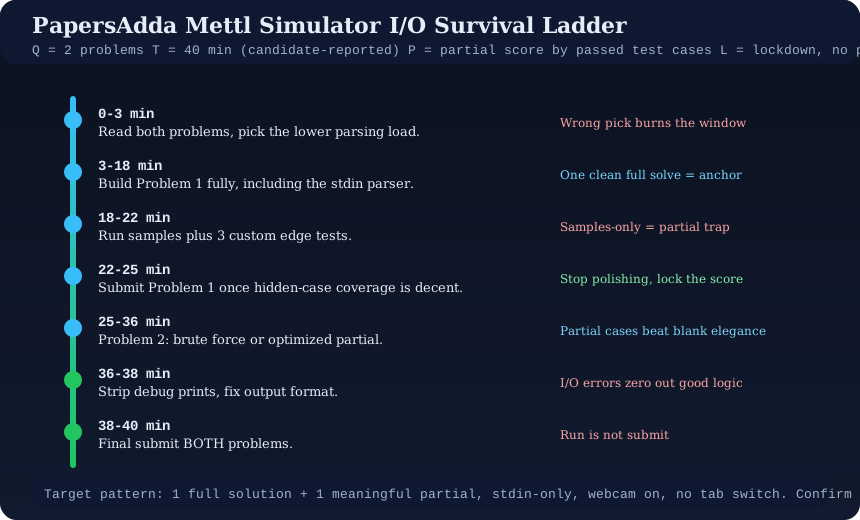
This framework uses 4 Mettl-specific variables: Q = 2 coding problems, T = 40 candidate-reported minutes, P = partial score through passed test cases, and L = lockdown risk with no paste or tab switching. The aim is not to write the prettiest solution. The aim is to push correct test-case count before the timer and proctoring environment create mistakes.
| Time block | Action | Score logic |
|---|---|---|
| 0-3 min | Read both problems, choose the lower parsing load | Wrong first pick kills the 40-minute window |
| 3-18 min | Build Problem 1 fully, including stdin parser | One clean full solve is the shortlist anchor |
| 18-22 min | Run samples plus 3 custom edge tests | Samples alone are a partial-score trap |
| 22-25 min | Submit Problem 1 if stable | Do not keep polishing after hidden-case coverage is decent |
| 25-36 min | Build Problem 2 brute force or optimized partial | Partial test cases beat blank elegance |
| 36-38 min | Remove debug prints, check output format | I/O errors convert good logic into zero or near-zero |
| 38-40 min | Final submit both problems | Run is not always submit |
Section-wise marking breakdown is employer-defined, so no exact cutoff should be treated as official. For practice, use this PapersAdda working model:
| Result pattern | PapersAdda working estimate | Selection risk |
|---|---|---|
| 2 full problems with hidden cases covered | 85-100 practice score | Low risk for coding screen |
| 1 full problem plus 50-70 percent of second | 65-80 practice score | Usually competitive for fresher coding filters |
| 1 full problem only | 45-60 practice score | Borderline if coding cutoff is strict |
| Only sample cases pass in both | 20-40 practice score | High risk because hidden cases decide partial score |
| Compile error, no final submit, or wrong input mode | 0-20 practice score | Likely elimination zone |
| Major proctoring flag during test | Score may be held or reviewed | Employer or proctor decision risk |
Accuracy target: aim for 80 percent hidden-case readiness on the first problem before chasing the second. Safe attempt range: 1 complete solution plus 1 meaningful partial in a 2-problem screen. Sectional risk: coding has no rescue section if the employer uses only Mettl coding as the screen.
Preparation Plan: 7-Day Drill Stack
This 7-day stack is for final-year and off-campus freshers who have a Mettl link coming soon. It maps directly to the pattern above, not to a generic DSA course.
Day 1, simulator setup:
- Do 4 stdin-output problems in your chosen language.
- Type your full boilerplate from memory 5 times.
- Turn off copy-paste during practice.
- Target: zero debug text in output.
Day 2, I/O repair:
- Solve 6 parsing drills: single line, multiline, arrays, strings with spaces,
Ttest cases, matrix input. - Write 10 custom test cases manually.
- Target: no scanner or buffer mistake under 15 minutes.
Day 3, arrays and strings:
- Solve 2 array problems and 2 string problems in 20 minutes each.
- Include duplicate values, empty cases, max-size cases, and case sensitivity.
- Target: first accepted solution before minute 18.
Day 4, hidden-case thinking:
- Take 3 old placement-style problems and write 5 hidden cases for each before coding.
- Force one brute-force partial if full optimization is slow.
- Target: learn when partial scoring is worth taking.
Day 5, language stability:
- C++ candidates: practise
getline, vectors, maps, sorting, andlong long. - Java candidates: practise fast input,
StringBuilder, arrays,HashMap, and class boilerplate. - Python candidates: practise
sys.stdin.read, split parsing, dictionaries, and avoiding slow nested loops. - Target: no syntax lookup needed.
Day 6, full Mettl mock:
- Run 2 problems in 40 minutes.
- Webcam on, browser full screen, no music, no second screen, no paste.
- Submit at minute 38 even if Problem 2 is partial.
- Target: 1 full plus 1 partial.
Day 7, proctoring rehearsal:
- Check webcam, mic, internet, browser, ID card, charger, and quiet room.
- Practise sitting centered in frame for 40 minutes.
- Do one final 2-problem mock with the exact same setup.
- Target: no window switch, no face-out-of-frame moment, no panic restart.
For off-campus planning beyond Mettl, use off-campus placement guide 2026 to map test windows, company shortlists, and interview follow-up. If your college also routes a free screening round, the HireMee free assessment guide 2026 covers that platform's score card and recruiter-view mechanics, and the AMCAT vs CoCubes vs eLitmus comparison helps you pick a paid test only if you need one.
Traps: Proctoring Flags And Partial-Score Killers
Mettl's proctoring resources describe webcam-based monitoring, live or recorded review, and AI or human proctoring configurations. Candidate-side implementation changes by employer, but the risk pattern is consistent: the platform can monitor your face, screen behavior, browser movement, and test-window discipline if those controls are enabled.
| Trap | Why it hurts on Mettl | Drill rule |
|---|---|---|
| Copy-paste dependence | Candidate reports mention paste disabled in lockdown mode | Type boilerplate and common loops from memory |
| Opening another tab | Navigation or away-from-window behavior can be flagged | Keep notes, docs, and IDEs closed before launch |
| Face not visible | Webcam proctoring can flag missing or partial face | Keep light in front, not behind |
| Looking down repeatedly | May look like phone or notes usage | Keep rough work minimal and visible if allowed |
| Phone on desk | Phone detection or manual review risk | Remove phone from table before starting |
| Screen-share or browser extension failure | Test may not launch or may pause | Run system check early, not at the last minute |
| Reading from file | Online judge expects stdin | Never use local file input in placement code |
| Printing prompts | Hidden output comparison fails | No Enter number or debug lines |
| Sample-only validation | Partial scoring may hide edge failures | Add custom tests for empty, duplicate, max, negative, and boundary values |
| Forgetting final submit | Running code may not equal final submission | Submit each problem deliberately |
The biggest partial-score killer is I/O handling. A correct algorithm with wrong parsing can fail every hidden case. A less optimal algorithm with correct parsing can still pass small and medium cases, giving useful partial score. That is why Mettl preparation must include input discipline, not just DSA revision.
Final Action: 40-Minute Test-Day Target
Before opening the real Mettl link, read the employer mail for exact duration, language options, allowed devices, proctoring instructions, and retake policy. If the mail does not publish details, use the PapersAdda working estimate: 2 problems, 40 minutes, 3 proctoring layers possible, partial scoring by test cases, and no dependable copy-paste.
Your final target is this: sit one 40-minute mock today with 2 coding problems, no paste, webcam on, full-screen discipline, stdin-only code, final submit by minute 38, and a score pattern of 1 full solution plus 1 partial solution.
FAQs
Q: Is the Mettl coding test always 2 questions in 40 minutes?
No. Mettl is a configurable assessment platform, not the hiring company. The 2-question, 40-minute setup is candidate-reported from some recent 2026 off-campus drives; the employer can change duration, language menu, proctoring, and scoring.
Q: Does Mettl give partial marks for coding questions?
Candidate reports suggest partial scoring through passed test cases in several Mettl-hosted coding rounds. Mercer Mettl publicly describes auto-graded evaluation through pre-built test cases, but exact per-case marks are set by the employer.
Q: Can I paste code inside the Mettl coding editor?
Do not depend on paste. Recent 2026 candidate reports mention copy-paste disabled inside the editor during full browser lockdown. Practise typing boilerplate and stdin parsing from scratch.
Sources and review notesreviewed 23 Jul 2026
Official notices, candidate reports, offer documents, and editorial practice questions carry different confidence levels. The visible source list lets you inspect the evidence instead of relying on a blanket verification badge.
topic cluster
More resources in Exam Patterns
Use the category hub to browse similar questions, exam patterns, salary guides, and preparation resources related to this topic.
paid contributor programme
Sat Mercer Mettl this year? Share your story, earn ₹500.
First-person experience reports help future candidates prep smarter. We pay verified contributors ₹500 via UPI per accepted story with byline.
Submit your story →ready to practice?
Take a free timed mock test
Put what you learned into practice. Our mock tests match the 2026 pattern with timer, navigator, reveal, and score breakdown. No signup.